

Many people wish to shop sustainably but face difficulties in doing so. There are just too many wrong or misleading green advertisements which confuse consumers and decrease their trust in green claims.
One of the tools that can help consumers identify truly green products at a glance is the EU Ecolabel. It’s the only EU-wide label that ensures certified products have a reduced environmental and health impact over the entire life cycle. At BEUC, we have been contributing for many years now to ensure it maintains high ambition.
More EU Ecolabel products than ever before
New figures released today show that interest in the EU Ecolabel keeps growing: 116,692 certified products are now available across Europe. An increase of 7% since the last stock-taking just six months ago. And around 60% of the label’s users are SMEs, showing that the EU Ecolabel offers benefits for both large and small companies.
But what these numbers don’t reveal is the local reality: how available are ecolabelled products really for consumers in their local supermarket? And is it true that buying greener is more expensive?
Is it true that buying greener is more expensive?
That was my motivation to organise a mystery shopping exercise together with our members and the European Environmental Bureau, to check the situation on the ground. 12 national consumer organisations contributed to our snapshot assessment of 73 supermarkets in 13 countries.[1] I got to do the mystery shopping in Belgium. We limited our search to several product groups that are commonly sold in supermarkets and that we expected could be ecolabelled: all-purpose cleaners, nappies, body lotions, and toilet paper.
Cheaper but patchy availability
The most striking findings: in most countries, ecolabelled products are, on average, cheaper than their non-certified counterparts. This is good news as it debunks the often-cited argument that sustainability comes at the expense of affordability.
The not-so-good news: the availability of ecolabelled products varies widely from country to country. While our Danish colleagues spotted ecolabels on as many as 80% of all products checked, colleagues in Greece and Cyprus had a much harder time with only 2% of the products they analysed being certified. This shows: whether it is easy, or even possible, to shop sustainably depends on where you live. And this should not be the case.
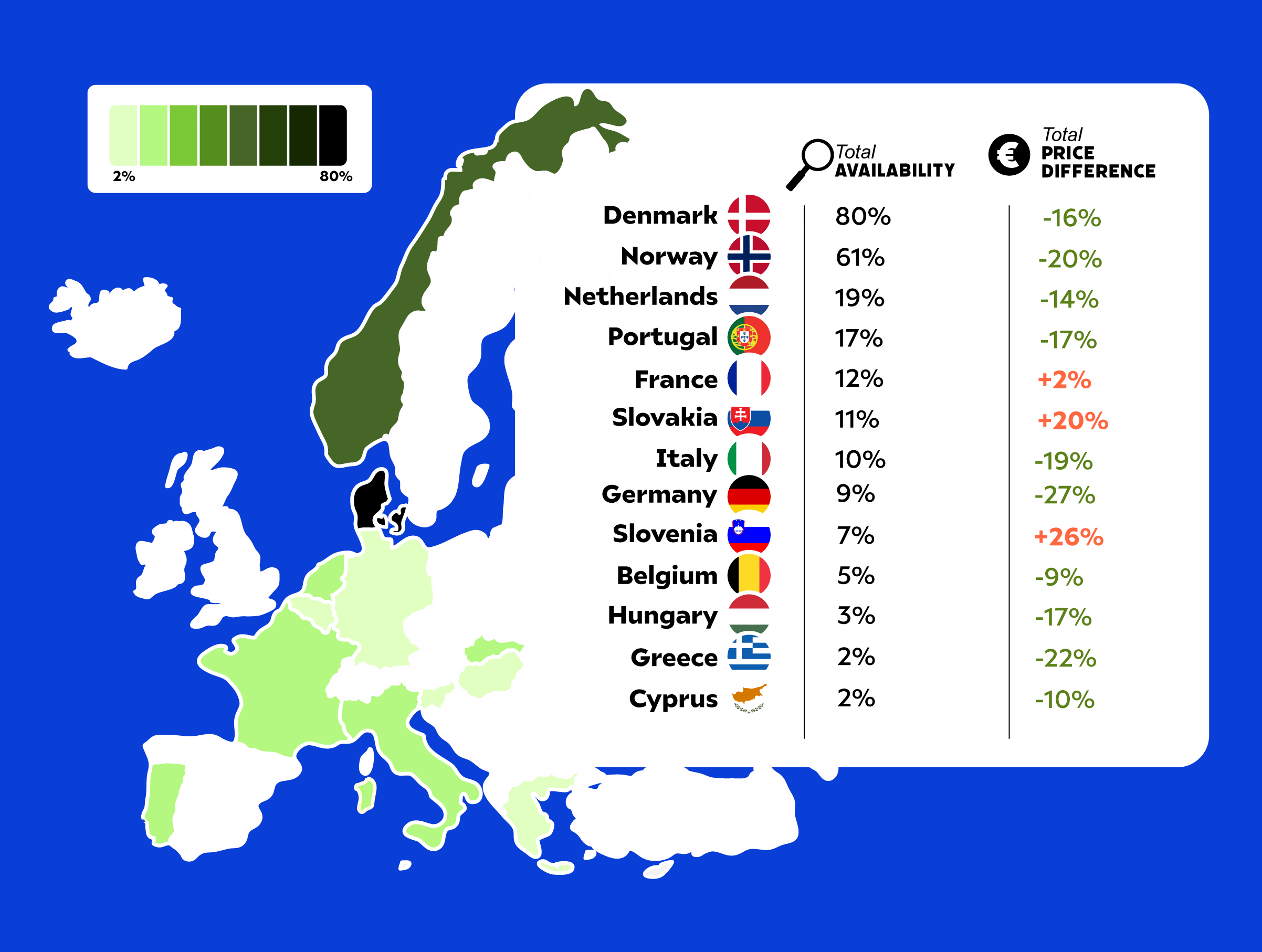
Above: The results of our mystery shopping exercise illustrate wide-ranging availability of ecolabelled products between countries.
Ecolabelled products hidden among wide product offer in Belgium
In Belgium, we are lucky to be able to choose from a very wide product offer. Quite often I found at least one EU Ecolabelled option. But if there are just one or two certified products among 40 all-purpose cleaners (that all fulfil more or less the same purpose), these can easily be overlooked. I found that it’s helpful if shops visually highlight the most eco-friendly options, while still offering them alongside the regular ones so that everybody looking for a detergent will notice them.
Unfortunately, I didn’t find any ecolabelled body lotions. That’s a shame because the EU Ecolabel for cosmetics comes with tight restrictions on hazardous substances. And especially for creams, I would like to be sure that I only put safe ingredients on my skin.
It also struck me how many green claims I spotted on the shelves. According to a study on behalf of the European Commission, 80% of non-food products are marketed as green. And that was my impression too: if not in the form of a written claim, then through the choice of green colour or nature-related visuals on the pack.
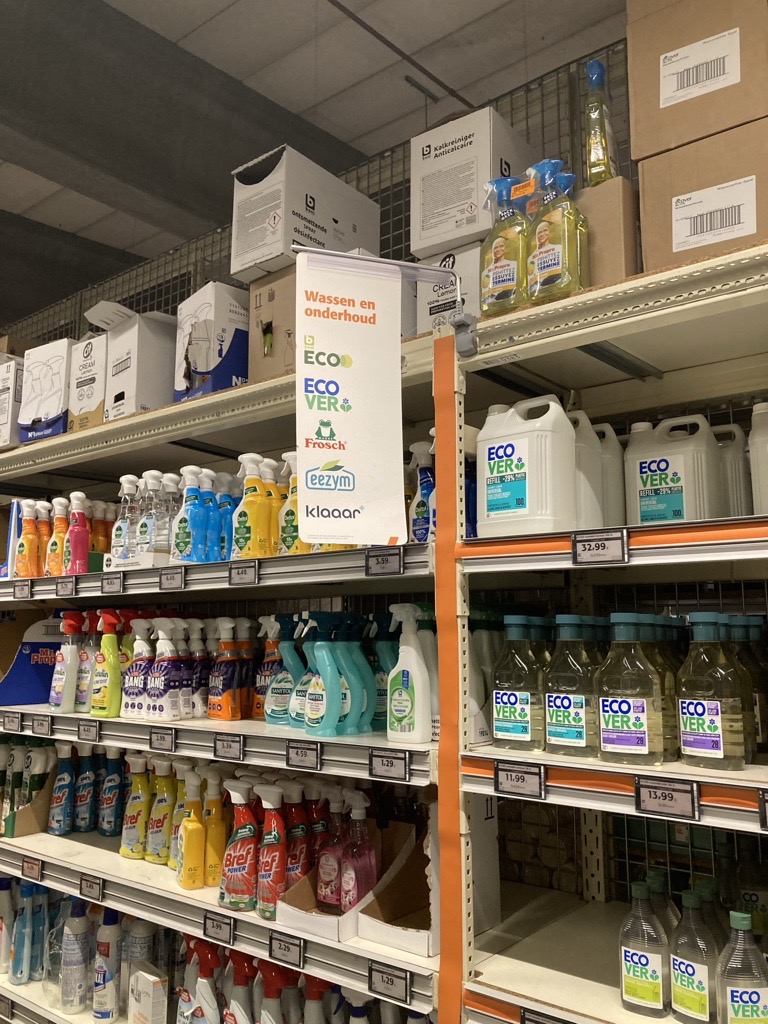
Above: the author found that finding ecolabelled products in Belgium can be tricky due to the sheer range of products on offer.
I realised that for those who don’t know the EU Ecolabel is a trustworthy mark of green excellence, the non-labelled product standing just next to it – also with green imagery and leaves all over the packaging – might seem just as eco-friendly. This can be quite confusing and misleading.
The EU Ecolabel is recognised as proof for credible green claims
Luckily, the EU recently agreed on a law – Empowering Consumers for the Green Transition – that sets stricter rules on green marketing. This should prevent products without substance having an ‘overly green’ appearance and make robust ecolabels stand out even more.
The EU Ecolabel is recognised as proof for credible green claims. And with the new rules applying as of September, now is an interesting moment for companies to consider certification.
Supermarkets in the spotlight
Supermarkets play a key role in ensuring sustainable products are available, visible, and affordable to consumers. Retailers can decide based on their assortment strategy which products to make available to consumers. They can create the conditions that make choosing the EU Ecolabel – or an equivalent scheme – the easy choice.
With our mystery shopping exercise we showed that shopping sustainably is not necessarily more expensive, even if there is work to do on accessibility.
Consumer groups across Europe (e.g. in France, Slovakia, Greece, and Portugal) are asking retailers – be it supermarkets or other traders – to step up their offer of reliably certified goods. and to request it from their suppliers too. That will not only benefit consumers but also place them one step ahead of tightening rules on green claims.
[1] Consumatori Italiani per l’Europa, Consumentenbond, Cyprus’ Consumers’ Association, DECO, EKPIZO, Tudatos Vásárlók Egyesülete, Forbrugerrådet Tænk, Forbrukerrådet, KEPKA, UFC Que Choisir, Spoločnosť ochrany spotrebiteľov, Zveza Potrošnikov Slovenije. Additional contributors: European Environmental Bureau, German Environment Agency & RAL gGmbH.